The Sun is a G-type main-sequence star (G2V Yellow Dwarf) that formed approximately 4.57 billion years ago. It contains about 99.86% of the Solar System's total mass and generates enormous amounts of energy through nuclear fusion in its core. Every planet, asteroid, comet, and moon orbits the Sun because of its immense gravitational pull.
The Sun's diameter is about 109 times larger than Earth's.
Mass
99.86%
The Sun contains approximately 99.86% of the Solar System's total mass.
Surface Temperature
5,500°C
The visible surface (photosphere) averages about 5,500°C.
Core Temperature
15 Million°C
The Sun's core reaches temperatures of roughly 15 million degrees Celsius.
Age
4.57 Billion Years
The Sun formed from a giant molecular cloud about 4.57 billion years ago.
Energy Source
Fusion
Hydrogen nuclei fuse into helium, releasing enormous amounts of energy every second.
Solar Overview
The Sun is the central star of our Solar System and the ultimate source of nearly all energy on Earth. Formed approximately 4.57 billion years ago from a collapsing cloud of gas and dust, it contains more than 99.86% of the Solar System's total mass. Through nuclear fusion in its core, the Sun converts hydrogen into helium, producing the immense heat and light that sustain life on Earth and drive the motion of every planet.
General Information
Type — G2V Yellow Dwarf
Age — 4.57 Billion Years
Diameter — 1,392,700 km
Mass — 1.989 × 10³⁰ kg
Distance from Earth — 149.6 Million km
Average Density — 1.41 g/cm³
Luminosity — 3.828 × 10²⁶ Watts
Rotation
Equator — 25 Earth Days
Mid Latitudes — 27 Days
Polar Regions — 35 Days
Differential Rotation — Yes
Gravity — 274 m/s²
Escape Velocity — 617.7 km/s
Magnetic Cycle — 11 Years
Composition
Hydrogen — 74%
Helium — 24%
Oxygen
Carbon
Neon
Iron
Other Heavy Elements
Internal Structure
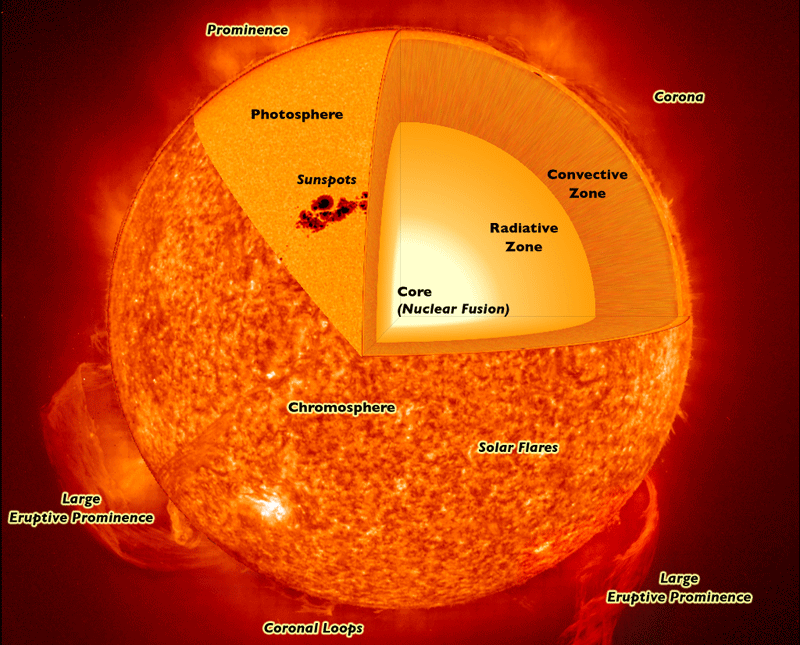
The Sun is composed of several distinct layers, each playing an important role in producing and transporting energy from the core into space.
🔥 Core
The core reaches temperatures of nearly 15 million°C where hydrogen nuclei fuse into helium, producing enormous amounts of energy.
🌞 Radiative Zone
Energy slowly moves outward as photons repeatedly scatter through dense plasma. This journey can take hundreds of thousands of years.
🌋 Convective Zone
Hot plasma rises while cooler plasma sinks, transporting energy to the Sun's visible surface.
Photosphere
The photosphere is the visible "surface" of the Sun. Although it appears solid, it is actually a thin layer of hot plasma approximately 500 km thick with an average temperature of about 5,500°C.
Temperature
Approximately 5,500°C
Thickness
Roughly 500 kilometers
Visible Features
Granules, faculae, and sunspots dominate the photosphere.
Chromosphere
Located above the photosphere, the chromosphere glows with a reddish color during total solar eclipses. It contains towering jets of hot plasma known as spicules.
Color
Deep reddish-pink during eclipses.
Temperature
4,500°C to over 20,000°C
Spicules
Thousands of plasma jets erupt every minute.
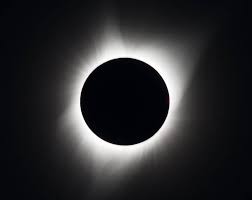
Solar Corona
The corona is the Sun's extremely hot outer atmosphere extending millions of kilometers into space. Surprisingly, it is much hotter than the Sun's visible surface, reaching temperatures of more than one million degrees Celsius.
Temperature
1–3 Million°C
Visible During
Total Solar Eclipses
Scientific Mystery
Scientists continue investigating why the corona is far hotter than the photosphere.
Nuclear Fusion
Every second, the Sun converts approximately 600 million tons of hydrogen into helium through nuclear fusion. A small portion of this mass becomes pure energy according to Einstein's equation E = mc², producing the sunlight and heat that power our Solar System.
Hydrogen Used
≈600 Million Tons per Second
Energy Released
3.8 × 10²⁶ Watts
Energy Source
Proton-Proton Fusion Chain
Solar Wind
The Sun continuously releases charged particles known as the solar wind. These particles travel throughout the Solar System, shaping planetary magnetospheres, creating auroras, and influencing space weather around Earth.
Speed
300–800 km/s
Composition
Electrons, Protons & Alpha Particles
Effects
Auroras, geomagnetic storms, and impacts on satellites and spacecraft.
Sunspots
Sunspots are temporary dark regions on the Sun's photosphere caused by intense magnetic activity. They appear darker because they are cooler than the surrounding surface, although they are still thousands of degrees Celsius. Sunspots often occur in groups and are closely linked to solar flares and coronal mass ejections.
Temperature
Approximately 3,500–4,500°C, making them cooler than the surrounding photosphere.
Cause
Powerful magnetic fields suppress convection, reducing the flow of heat.
Solar Cycle
The number of sunspots rises and falls during the Sun's 11-year activity cycle.
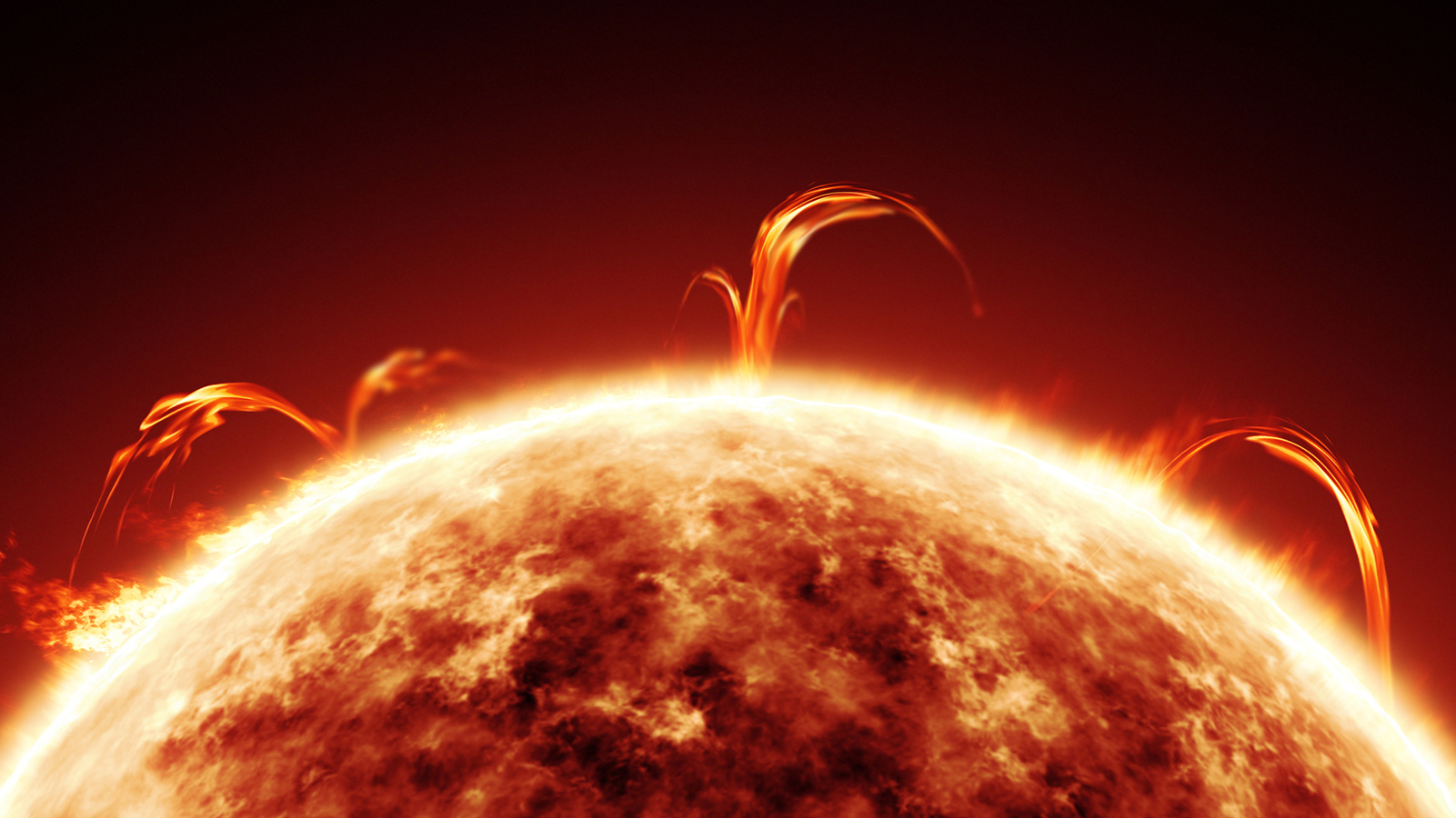
Solar Flares
Solar flares are sudden explosions of energy caused by the release of magnetic energy near sunspots. They emit intense radiation across the electromagnetic spectrum, including X-rays, ultraviolet light, and radio waves.
Energy Released
Equivalent to billions of hydrogen bombs exploding simultaneously.
Duration
Usually lasts from a few minutes to several hours.
Effects
Can disrupt satellites, GPS systems, radio communications, and electrical power grids on Earth.
Coronal Mass Ejections (CMEs)
A Coronal Mass Ejection is a massive eruption of plasma and magnetic fields from the Sun's corona. When directed toward Earth, CMEs can produce powerful geomagnetic storms capable of generating spectacular auroras and affecting modern technology.
Speed
300–3,000 km/s
Material
Billions of tons of ionized plasma.
Travel Time
Typically reaches Earth within 1–3 days.
Solar Magnetic Field
The Sun's magnetic field is generated by the movement of electrically charged plasma inside its interior. This magnetic field constantly changes, twists, and reconnects, driving solar activity throughout the Solar System.
Magnetic Cycle
Approximately 11 years.
Pole Reversal
The Sun's north and south magnetic poles reverse during each solar cycle.
Importance
Controls sunspots, flares, CMEs, and space weather throughout the Solar System.
Effects on Earth
The Sun makes life on Earth possible by providing light and heat. However, powerful solar storms can also interfere with satellites, communications, navigation systems, and electrical infrastructure.
🌎 Climate
Provides the energy that drives Earth's weather and climate systems.
🌈 Auroras
Charged solar particles interacting with Earth's magnetic field create the Northern and Southern Lights.
📡 Technology
Strong geomagnetic storms can affect satellites, astronauts, GPS, and power grids.
Parker Solar Probe
NASA's Parker Solar Probe is the fastest human-made object ever built. Launched in 2018, it repeatedly flies through the Sun's corona to study the origin of the solar wind, magnetic fields, and the heating of the corona.
Launch
August 12, 2018
Agency
NASA
Top Speed
More than 690,000 km/h, making it the fastest spacecraft ever built.
Main Goal
Study the Sun's outer atmosphere and improve our understanding of solar activity.
Solar Exploration Timeline
1610
Galileo Galilei used a telescope to observe sunspots.
1976
Helios spacecraft began studying the inner Solar System and the Sun.
1995
SOHO was launched to continuously observe the Sun.
2010
Solar Dynamics Observatory (SDO) began high-resolution observations.
2018
Parker Solar Probe launched toward the Sun.
2020
ESA's Solar Orbiter began studying the Sun's poles and magnetic activity.
Amazing Sun Facts
☀ Solar Mass
The Sun contains 99.86% of the Solar System's total mass.
⚛ Fusion
Every second, around 600 million tons of hydrogen are converted into helium.
💡 Energy
Sunlight takes about 8 minutes and 20 seconds to travel from the Sun to Earth.
🌌 Lifetime
The Sun is expected to shine for about another 5 billion years before becoming a red giant.
🌍 Life
Nearly every form of life on Earth ultimately depends on energy from the Sun.
🚀 Exploration
The Parker Solar Probe is flying closer to the Sun than any spacecraft in history.
The Sun: The Heart of Our Solar System
The Sun is the engine that powers the Solar System. Every planet, moon, asteroid, and comet is held in orbit by its enormous gravitational pull. Although it appears as an ordinary star among billions in the Milky Way, the Sun is extraordinary to humanity because it makes life on Earth possible. Without its continuous supply of light and heat, our planet would be a frozen world incapable of supporting oceans, weather, or living organisms.
Deep inside the Sun's core, hydrogen atoms are continuously fused into helium through nuclear fusion. This process converts a tiny amount of matter into enormous quantities of energy, following Einstein's famous equation E = mc². The energy produced in the core slowly travels outward through the radiative and convective zones before finally escaping from the photosphere as sunlight. The light reaching Earth today began its journey from the Sun's surface about 8 minutes ago, although the energy itself may have spent hundreds of thousands of years moving outward from the core.
The Sun is also an active magnetic star. Sunspots, solar flares, and coronal mass ejections constantly reshape its atmosphere and influence space weather throughout the Solar System. These powerful eruptions can create beautiful auroras on Earth while also disrupting satellites, communication systems, navigation networks, and electrical power grids. Understanding these events is one of the major goals of modern solar physics.
Modern missions such as NASA's Parker Solar Probe and ESA's Solar Orbiter are revolutionizing our understanding of the Sun. By flying closer than any spacecraft before, these missions are helping scientists explain why the corona is millions of degrees hotter than the visible surface, how the solar wind is accelerated, and how magnetic fields generate solar storms. Their discoveries not only deepen our understanding of our own star but also improve our knowledge of stars throughout the universe.
Sun Gallery
Representative scientific imagery from NASA, ESA, SOHO, SDO, Parker Solar Probe, and Solar Orbiter.
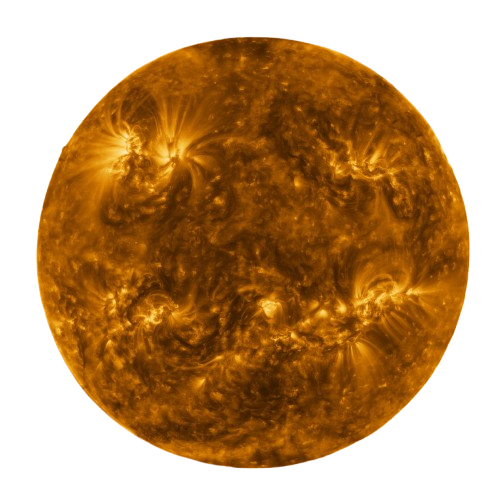
Visible Surface
The photosphere showing sunspots and granulation.
Solar Corona
The Sun's outer atmosphere visible during a total solar eclipse.
Solar Flare
A massive eruption releasing tremendous energy into space.
Frequently Asked Questions
What type of star is the Sun?
The Sun is classified as a G2V main-sequence star, commonly called a Yellow Dwarf.
How old is the Sun?
The Sun formed approximately 4.57 billion years ago and has enough hydrogen to continue shining for about another 5 billion years.
Why is the Sun hot?
Nuclear fusion in the Sun's core converts hydrogen into helium, releasing enormous amounts of energy.
How long does sunlight take to reach Earth?
Sunlight travels from the Sun to Earth in approximately 8 minutes and 20 seconds.
Can the Sun explode?
No. The Sun is not massive enough to become a supernova. Instead, it will eventually become a red giant and later a white dwarf.
Why is studying the Sun important?
Understanding the Sun helps protect satellites, astronauts, communication systems, and electrical infrastructure from space weather.