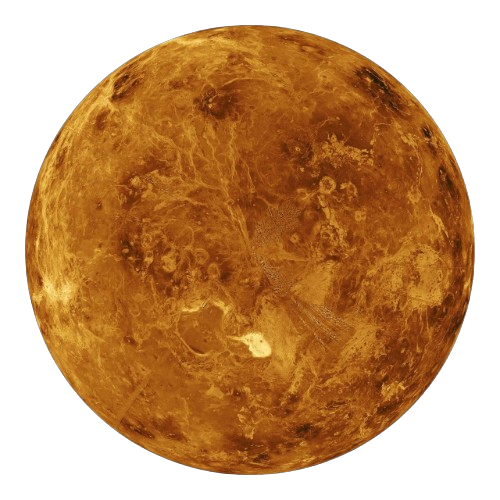
Venus is the second planet from the Sun and Earth's closest planetary neighbor. Often called Earth's "twin" because of its similar size and mass, Venus is actually the hottest planet in the Solar System due to its dense carbon dioxide atmosphere and powerful greenhouse effect. Thick clouds of sulfuric acid permanently hide its volcanic surface from visible light.
Nearly the same size as Earth, making Venus Earth's closest planetary twin.
Surface Temperature
465°C
The hottest planetary surface in the Solar System.
Length of Year
225 Days
Venus completes one orbit around the Sun in approximately 225 Earth days.
Natural Moons
0
Venus has no natural satellites or ring system.
Venus Overview
Venus is the second planet from the Sun and the closest planetary neighbor to Earth. Although often called Earth's "sister planet" because of its similar size, mass, and composition, Venus evolved into one of the most extreme environments in the Solar System. A dense atmosphere rich in carbon dioxide traps enormous amounts of heat through a runaway greenhouse effect, producing surface temperatures hot enough to melt lead.
Planet Classification
Planet Type — Terrestrial Planet
Solar System Order — 2nd Planet
Average Distance — 108.2 Million km
Orbital Period — 224.7 Earth Days
Rotation Period — 243 Earth Days
Average Orbital Speed — 35.0 km/s
Axial Tilt — 177.4° (Retrograde)
Physical Characteristics
Diameter — 12,104 km
Radius — 6,051.8 km
Mass — 4.87 × 10²⁴ kg
Density — 5.24 g/cm³
Surface Gravity — 8.87 m/s²
Escape Velocity — 10.36 km/s
Natural Satellites — None
Environment
Atmosphere — 96.5% Carbon Dioxide
Clouds — Sulfuric Acid
Surface Pressure — 92 Earth Atmospheres
Average Temperature — 465°C
Magnetic Field — None (Global)
Water — Extremely Dry
Volcanoes — Thousands
Atmosphere
Venus possesses the densest atmosphere of any rocky planet. Carbon dioxide makes up nearly 96.5% of the atmosphere, while thick clouds of sulfuric acid permanently hide the planet's surface from visible light. Atmospheric pressure at the surface is about ninety-two times greater than Earth's.
Main Gas
96.5%
Carbon dioxide dominates the Venusian atmosphere.
Pressure
92× Earth
Standing on Venus would feel similar to being nearly one kilometer beneath Earth's oceans.
Clouds
H₂SO₄
Clouds consist primarily of sulfuric acid droplets.
Wind Speed
360 km/h
Powerful upper-atmosphere winds circle the planet in only a few days.
Runaway Greenhouse Effect
Venus is the hottest planet in the Solar System—not Mercury—because its thick carbon dioxide atmosphere traps heat extremely efficiently. Sunlight enters the atmosphere, warms the surface, and the escaping infrared radiation becomes trapped, creating an extreme greenhouse effect.
Surface Temperature
Average temperatures remain close to 465°C across almost the entire planet.
Why So Hot?
Dense carbon dioxide absorbs outgoing heat, preventing the planet from cooling efficiently.
Scientific Importance
Venus provides scientists with an important example of how greenhouse gases can dramatically affect planetary climates.
Internal Structure
Like Earth, Venus is believed to contain a metallic iron core surrounded by a rocky mantle and crust. However, unlike Earth, Venus shows no evidence of active plate tectonics.
Core
Iron-Nickel
Scientists believe Venus contains a large metallic core similar to Earth's.
Mantle
Rocky
The mantle likely drives volcanic activity through slow convection.
Crust
Basaltic
Large volcanic plains cover much of the planet's surface.
Tectonics
No Plates
Venus lacks Earth's modern system of moving tectonic plates.
Volcanoes & Surface
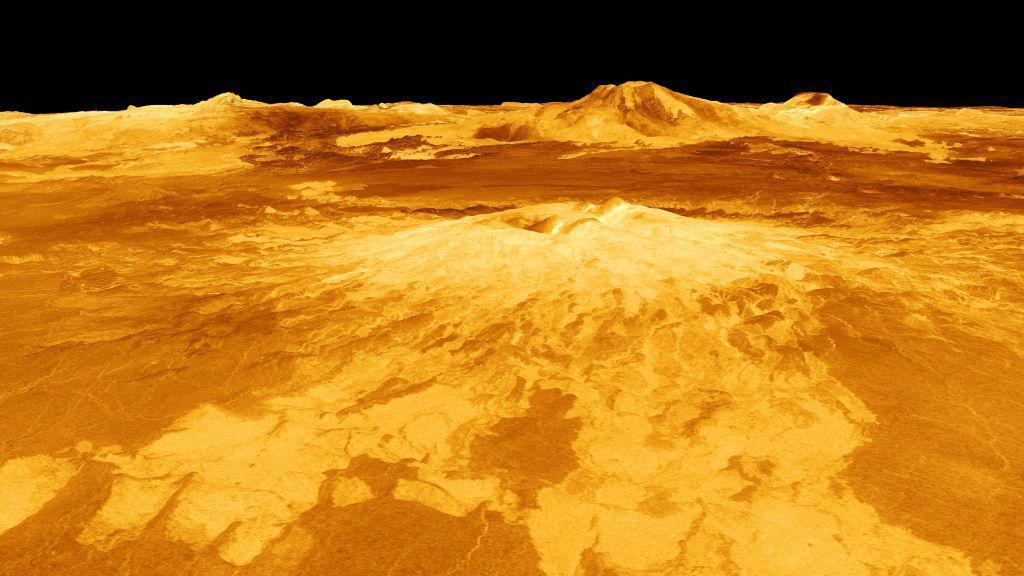
Radar observations reveal a world dominated by volcanic plains, lava flows, mountains, impact craters, and giant shield volcanoes. Venus may still be volcanically active today.
Maxwell Montes
The highest mountain range on Venus rises approximately 11 kilometers above the surrounding plains.
Maat Mons
One of the tallest volcanoes on Venus and a strong candidate for recent volcanic activity.
Volcanic Plains
Extensive lava flows have resurfaced much of Venus over hundreds of millions of years.
Magnetic Field
Unlike Earth, Venus does not possess a strong global magnetic field generated by an active internal dynamo. Instead, the planet has an induced magnetosphere created when the solar wind interacts with its upper atmosphere. This leaves the atmosphere more exposed to charged particles from the Sun and has likely contributed to the gradual loss of water over billions of years.
No Global Magnetic Field
Venus lacks a powerful internally generated magnetic field like Earth's.
Induced Magnetosphere
The solar wind compresses Venus' upper atmosphere and creates a temporary magnetic shield.
Atmospheric Escape
Without a strong magnetic field, hydrogen and oxygen atoms can gradually escape into space.
Space Missions
Venus has been explored by numerous spacecraft from the Soviet Union, NASA, ESA, and JAXA. These missions have transformed our understanding of the planet's atmosphere, geology, climate, and volcanic history.
Venera Program
1961–1984
The Soviet Venera missions achieved the first successful landings on another planet and returned the first photographs from the surface of Venus.
Magellan
1989–1994
NASA's Magellan spacecraft mapped almost the entire Venusian surface using radar, revealing volcanoes, mountains, and lava plains.
Venus Express
2005–2014
ESA studied the atmosphere, weather systems, and atmospheric escape processes around Venus.
Mariner 2 became the first spacecraft to successfully fly past another planet, collecting valuable data about Venus.
1970
Venera 7 became the first spacecraft to successfully land on another planet and transmit data from the surface.
1982
Venera 13 returned the first color photographs from the surface of Venus.
1990
Magellan entered orbit and produced the highest-resolution radar maps of Venus ever created.
2006
ESA's Venus Express began a detailed investigation of the atmosphere and climate.
2015
JAXA's Akatsuki successfully entered orbit after an earlier failed attempt, beginning long-term atmospheric observations.
Interesting Facts
🌡 Hottest Planet
Venus is hotter than Mercury even though Mercury is closer to the Sun.
🔄 Retrograde Rotation
Venus rotates in the opposite direction of most planets in the Solar System.
☁ Thick Clouds
Its clouds are made primarily of sulfuric acid droplets.
📅 Long Day
One day on Venus lasts longer than one Venusian year.
🌋 Thousands of Volcanoes
Scientists have identified thousands of volcanic structures across the planet.
🌍 Earth's Twin
Venus is very similar to Earth in size, mass, and density, but evolved into an entirely different world.
Scientific Importance
Venus provides scientists with a natural laboratory for studying climate evolution, greenhouse effects, volcanic activity, atmospheric circulation, and planetary evolution. By comparing Venus with Earth, researchers gain valuable insight into how small differences in planetary conditions can lead to dramatically different environments.
Climate Science
Venus demonstrates the long-term effects of an extreme greenhouse atmosphere.
Planetary Evolution
Studying Venus helps scientists understand why Earth remained habitable while Venus became hostile.
Exoplanets
Many rocky exoplanets discovered around other stars may resemble Venus more closely than Earth.
Future Missions
Upcoming spacecraft will investigate Venus' atmosphere, geology, and possible ongoing volcanic activity.
Why Venus Matters
Venus is one of the most scientifically important planets in the Solar System. Although it shares many similarities with Earth in size, density, and composition, it evolved into an extremely hostile world with crushing atmospheric pressure, scorching temperatures, and acidic clouds. Understanding why Venus and Earth followed dramatically different evolutionary paths helps scientists better understand planetary climates, atmospheric evolution, and the future of rocky planets.
Venus likely possessed large amounts of water billions of years ago. As the young Sun became brighter, increasing temperatures caused oceans to evaporate. Water vapor, itself a greenhouse gas, trapped even more heat. Eventually, ultraviolet radiation split water molecules into hydrogen and oxygen, allowing the lightweight hydrogen to escape into space. Over time, Venus transformed into the dry, overheated world we observe today.
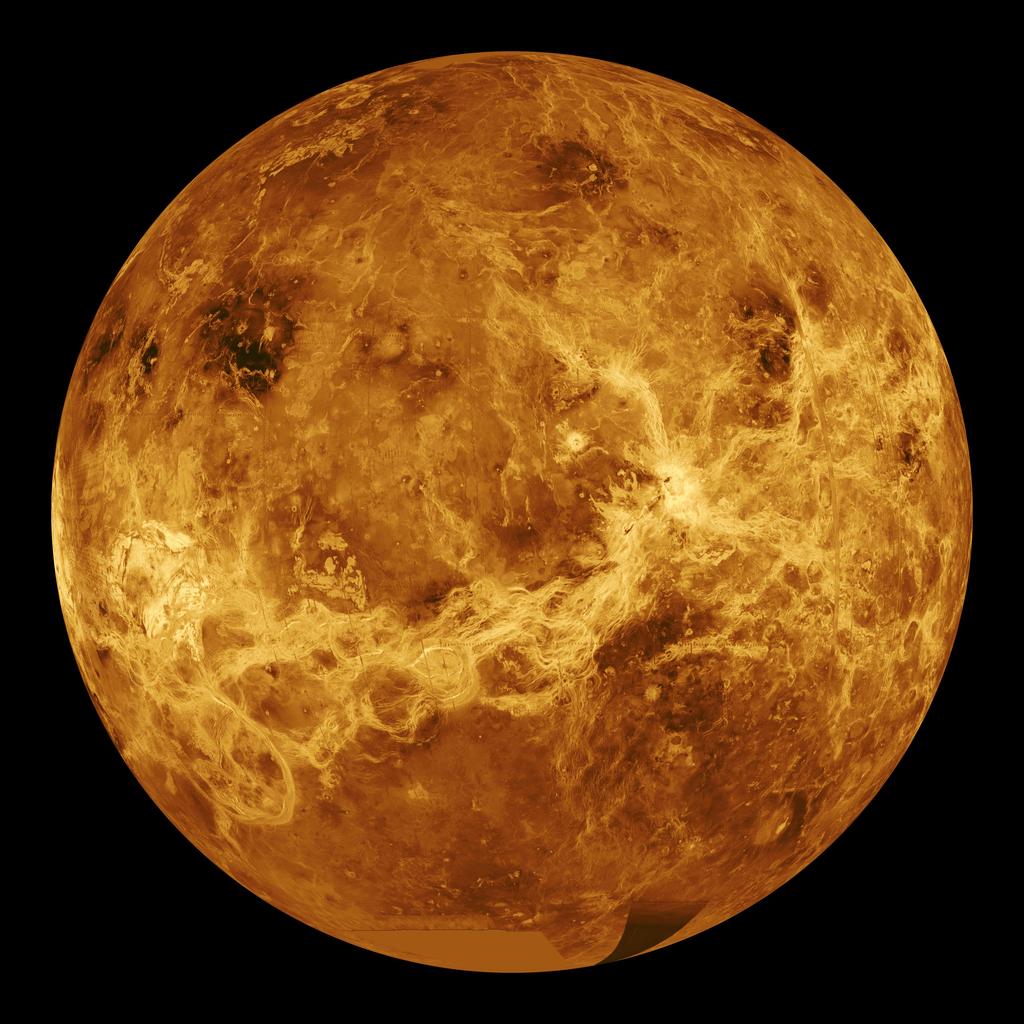
Radar observations from NASA's Magellan mission revealed enormous volcanic plains, giant shield volcanoes, extensive lava flows, and mountain ranges hidden beneath thick clouds. Some recent observations even suggest that volcanic eruptions may still be occurring today, indicating that Venus could remain geologically active.
Scientists also study Venus to understand rocky exoplanets discovered around distant stars. Many Earth-sized exoplanets orbit close to their stars and may resemble Venus more closely than Earth. Research on Venus therefore provides valuable insight into the evolution of terrestrial worlds throughout the Milky Way Galaxy.
Venus Gallery
Images inspired by spacecraft observations and scientific visualization.
Global View
A global ultraviolet view of Venus highlighting its dense cloud layers.
Volcanic Surface
Radar imagery reveals enormous volcanic plains hidden beneath the clouds.
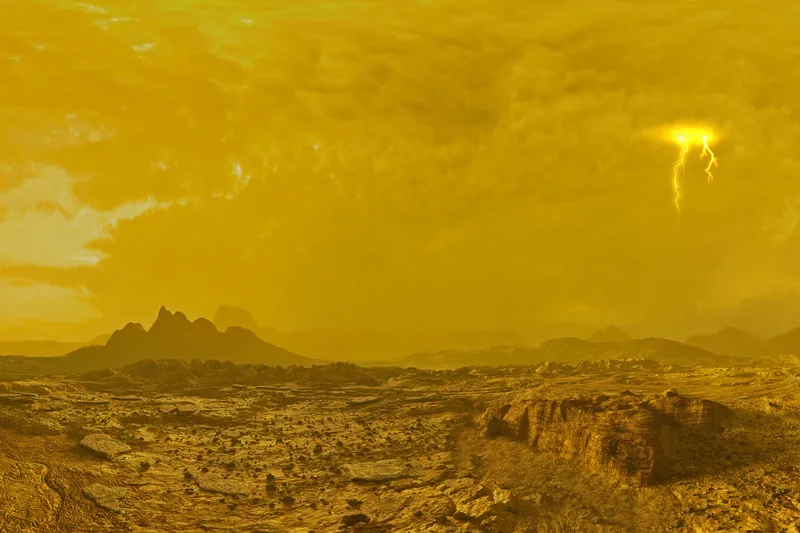
Atmosphere
Thick sulfuric acid clouds completely cover the planet.
Frequently Asked Questions
Why is Venus hotter than Mercury?
Venus has a thick carbon dioxide atmosphere that traps heat through a powerful greenhouse effect, making it hotter than Mercury despite being farther from the Sun.
Can humans live on Venus?
No. The extremely high temperatures, crushing atmospheric pressure, and acidic clouds make the surface uninhabitable with current technology.
Does Venus have moons?
No. Venus has no known natural satellites or ring system.
Why does Venus rotate backward?
Scientists are still investigating the cause. One possibility is that a massive collision early in the planet's history altered its rotation.